
David Hume's Gift to Theology
The Epistemological Boundary Science Cannot Cross

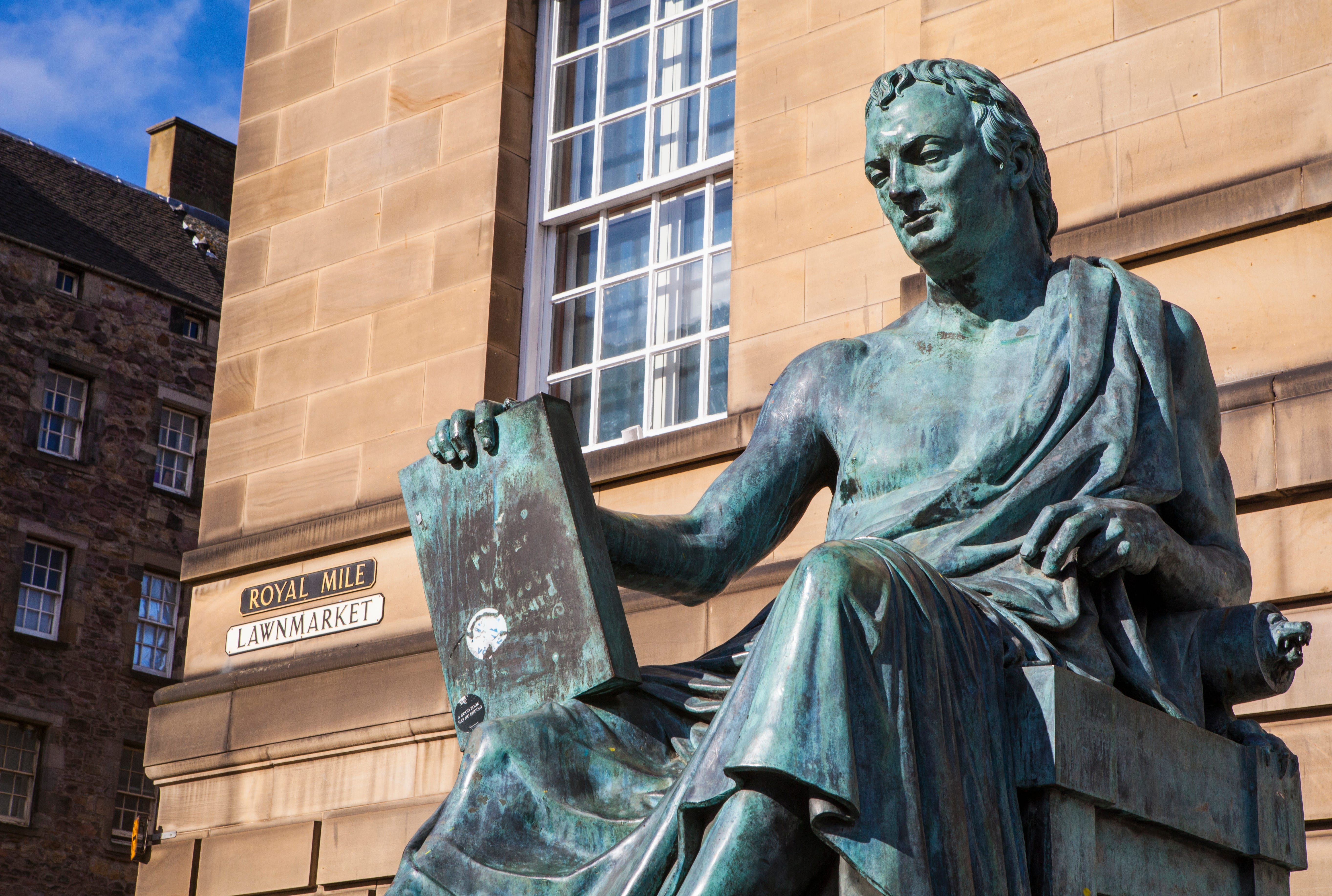
While on vacation a few weeks ago, I read Arthur Herman’s How the Scots Invented the Modern World, and it reminded me why Hume still matters. He was not on any of my reading lists at Westminster Theological Seminary, but that is how rabbit holes work in graduate school. Working my way through Dr. Poythress’s Faith & Science class, I pull one thread and end up three books deep, stacked on my lampstand next to my bed. Hume kept showing up, and eventually (though not an easy read), I read him directly, specifically his work on human understanding and the problem of induction, An Enquiry Concerning Human Understanding. Most people recruit Hume to challenge religion. I think that gets it exactly backward. His inquiry into human understanding does not close the door on God. Rather, it exposes the crack in the foundation of the argument that science already has, which turns out to be a gift to theology, whether he intended it that way or not.
The Problem Hume Exposed
Here's the challenge with science in plain terms. No accumulation of past instances guarantees the next one. No warrant justifies the conclusion. The sun has risen every morning in human memory, but that does not guarantee it will rise tomorrow. We assume nature is regular, but we cannot prove it. The mental shift from "has always been" to "will always be," as natural as it feels, is not a warrant. Hume used a peculiar term, calling it 'custom'. He was not attacking science itself or saying it doesn't work. Science is genuinely useful. However, what he deflated was the pretense that science arrives at certainty, that it proves things the way a mathematical proof proves things. Hume established that custom is not a warrant. They are not the same.
Custom Cannot Justify Custom
But this is where most people stop, and I think it gets interesting when you think about it. Induction cannot even function without prior commitments; it has no power to justify. Toulmin’s The Uses of Argument, an old textbook from my college days, gives us the language we need here. Every argument moves from grounds, the data and observations, to a claim, by way of a warrant, the rule that licenses the move. In science, that warrant is induction itself: past observations reliably predict future ones. But a warrant needs backing, some further reason why it should be trusted. And that is where it breaks down. The only available backing for induction is that it has worked in the past. Before a scientist infers anything from a pattern, he assumes that nature is uniform, that the future will resemble the past, that what is true here is true there. Those assumptions, which we call warrants, are not scientific conclusions. They are presuppositions that science requires. Strip them away, and the method has no basis to stand on.
So I’ll lean into it a little harder. How do we know the warrant is reliable? The only available answer is that it has worked reliably in the past, which is itself an inductive argument. Think about it. The backing assumes the warrant it is trying to support. In other words, the scientific method is based on a warrant of circular reasoning. This is where Hume drops the microphone.
Now, some will point to Bayesian inference as the way out of this circle. Instead of claiming certainty, we rely on probability, updating it as evidence accumulates. In Toulmin’s terms, this introduces a qualifier, softening the claim from “certainly” to “probably.” As an engineer, I find it a genuinely fascinating approach, since Bayesian inference is a staple in machine learning, and it works well within its limits. But this qualifier is not a warrant. Prior probabilities still have to come from somewhere, and that somewhere is the same unprovable assumption that nature is regular. The circle does not disappear. It just gets buried in the algorithm. Notwithstanding, the point is not that science fails. It is that science is pragmatically reliable without being epistemically grounded. This distinction matters.
If the assumption that nature is uniform cannot be established by science itself, then, technically, science does not prove anything in the strict sense. But science cannot prove any of that. It models and predicts. And it does both remarkably well. But, still, it cannot prove its own first principles. Every scientific law, i.e., gravity, thermodynamics, and electromagnetism, is a generalized expectation presented as fact (and quantum mechanics undermining all of it). We observe a pattern, we expect it to continue, and we present that expectation as a logical conclusion. So technically, the person who says he follows only the evidence is standing on an assumption about evidence that he ultimately cannot prove, an assumption about nature's uniformity that precedes every observation.
When Science Becomes Philosophy
To clarify, science operates under what philosophers call methodological naturalism: the working assumption that natural causes are sufficient for scientific explanation. But science is a posture of inquiry, not a verdict on reality. The error comes when we move from methodology to metaphysics, claiming that nature is all there is to reality. In Toulmin’s terms, the grounds have not changed. But the claim has expanded far beyond what any warrant could support. Therefore, it is no longer a scientific finding. Instead, it is a philosophical commitment. And this is how science gets weaponized.
The Ground of Reason Itself
So how can science disprove God? This is where Augustine enters the picture. God, as Augustine understood him, is not a natural object inside the universe. He is the ground of being itself, the uncaused cause, the one in whom all contingent things exist. Augustine’s point, worked out through the Confessions and sharpened in De Trinitate, is that the mind’s ability to know anything at all already depends on a rationality it did not produce. We do not first understand and then believe. We believe in order to understand. Understanding requires prior trust in the rationality of things. The trust is the warrant that makes reason possible. Hence, faith is not the enemy of reason. Rather, it comes first. Everything turns on it.
The distinction between the creator and creature is clear. God does not show up in a spectrometer reading. He is not a variable. He is the reason there are variables at all. A metal detector cannot tell you whether a symphony is beautiful. If you use a metal detector to judge music, it fails. Not because symphonies are not real, but because the metal detector was never designed to measure beauty. Obviously, the limitation is in the instrument, not the music. The same is true for science and God. Science cannot reach the question of God’s existence because the scientific method was never designed to measure what is beyond the natural order. The limitation is in the tool, not in God.
In his book, The Logic of Scientific Discovery, Popper clarified the boundary in a way that sharpens this point. He argued that a theory is scientific precisely because it can, in principle, be proven wrong. In Toulmin’s terms, falsifiability becomes the condition a claim must meet to enter the argument at all. Unfalsifiable claims do not fail the test. They fall outside the jurisdiction where the test applies. Similarly, the existence of God cannot be falsified. No experiment can settle it because the claim is metaphysical, and theologians have always known this. And yet the people claiming to speak for science keep missing the point.
The overreach here is cultural, not scientific. Dawkins and Harris take the claim far beyond what the grounds and warrant can support and then present the result as science. Hume would have found this sloppy. His skepticism cuts just as deep against scientific naturalism as religious claims. I’d say Hume is an equal-opportunity skeptic.
When you put both problems together, the picture becomes clear. The claim that science disproves God collapses on both ends. The warrant is circular, and the claim is not within the method’s reach in the first place.
The Scandalous Method
Here is where it ends, at least for me. The person who says he follows the evidence and nothing else is standing on ground he did not lay, cannot inspect, and cannot justify by the very method he is defending.
It seems to me that a method that cannot justify its own warrant and then claims to have disposed of God is scandalous. Every system of thought stands on commitments it cannot prove from within itself. The honest move is to acknowledge it and then ask which set of presuppositions best explains why the universe is the kind of place where evidence means anything at all. Augustine’s answer was that the intelligibility of creation reflects the rationality of its Creator. For me, this offers a coherent account of reason that can actually sustain itself.
David Hume’s gift to theology is not a proof of God. Rather, a quiet exposure of the pretense that science can disprove him.
S.D.G.